
How to Research the Crime Rate in Idaho: A Data Guide
Reviewed by Garrett Pancheri and Dustin Cagle
Team Leaders, Living In Idaho | LPT Realty | View Profile
When you are choosing where to live, "is it safe?" is a natural question, and the useful answer comes from official data you can look up yourself, not from opinions or reputation. Learning to read the crime rate in Idaho, whether you are comparing Boise crime statistics, checking a Boise Idaho crime map, or simply asking "is Idaho safe," puts an objective tool in your hands. We always encourage buyers relocating to Idaho to research the numbers directly, since it is the fairest, most accurate way to evaluate an area. This guide shows you exactly which official sources to use and how to interpret them.
Research Idaho areas with confidence Homes for sale in Idaho | Idaho communities | Affordability Calculator
Quick Answer: How Do You Research Crime and Safety Data in Idaho?
To research crime and safety data in Idaho, use official sources: the FBI Crime Data Explorer for national comparisons, individual city police department dashboards and annual reports, and Idaho State Police Uniform Crime Reporting data. Compare rates per 1,000 residents (not raw counts), look at multi-year trends rather than single years, and combine the data with your own visits at different times of day. Always rely on official statistics rather than reputation or hearsay.
Key Takeaways
- Use official sources only, FBI, state police, and city police data, not opinion sites.
- Compare rates, not raw numbers, per-capita rates make different-sized areas comparable.
- Look at multi-year trends, one year can be an outlier; direction matters more.
- Combine data with personal visits at different times of day.
- Focus on facts, not reputation, objective data is the fair-housing-appropriate way to evaluate an area.
Table of Contents
- Quick Answer
- Key Takeaways
- Why Official Data Beats Reputation for the Crime Rate in Idaho
- Source 1: FBI Crime Data Explorer
- Source 2: Local Police Departments
- Source 3: Idaho State Police
- What the Data Shows About the Crime Rate in Idaho
- Official Crime-Data Sources
- How to Read Crime Statistics
- Frequently Asked Questions
- Conclusion
Why Official Data Beats Reputation for the Crime Rate in Idaho
Safety is one of the most common relocation questions, and also one of the easiest to get wrong if you rely on reputation, anecdotes, or rankings from sites with unclear methodology. Official crime data is collected consistently, updated regularly, and free to access. Using it keeps your evaluation objective and grounded in facts about reported incidents, not assumptions about who lives somewhere. That distinction matters: the goal is to understand an area’s data, and let that inform your own judgment. This approach also aligns with fair housing best practices, which focus on objective property and area facts rather than assumptions about who lives somewhere.
Source 1: FBI Crime Data Explorer
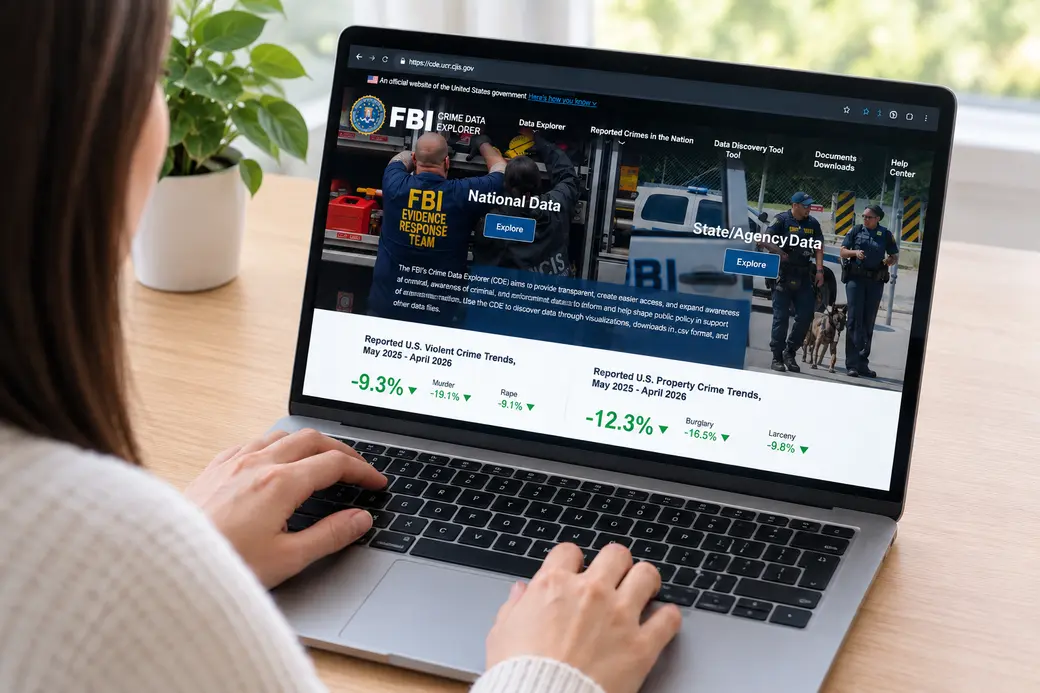
The FBI’s Crime Data Explorer is the best starting point for national and city-level comparisons. It aggregates reported offenses from law-enforcement agencies across the country, so you can compare an Idaho city against state and national figures using a consistent methodology. Look at both violent and property-crime categories, and note that not every small agency reports every year, gaps are normal.
Source 2: Local Police Departments
City police departments often publish the most current and granular data. Boise, Meridian, Nampa, Caldwell, and Coeur d’Alene police departments typically offer annual reports, and some provide online dashboards or map-based crime portals updated monthly. These are excellent for seeing recent trends and understanding how a department categorizes and responds to incidents. Check the department’s official website directly.
Source 3: Idaho State Police
The Idaho State Police compiles statewide Uniform Crime Reporting (UCR) data, which rolls up reports from agencies across Idaho. This is useful for comparing cities and counties within the state on a consistent basis and for seeing longer-term statewide trends. Because it uses standardized categories, it complements the FBI data well.
What the Data Shows About the Crime Rate in Idaho
When you pull the official numbers, Idaho generally comes out well. Recent data compiled by USAFacts puts Idaho's violent crime rate around 231 offenses per 100,000 residents and its property crime rate around 736 per 100,000, both notably below national averages. State figures from the Idaho State Police Crime in Idaho dashboard show overall crime holding steady or declining across major population centers, including Ada and Canyon counties.
The mix of offenses matters as much as the totals. Aggravated assaults make up the largest share of violent incidents, while larceny-theft accounts for roughly three-quarters of property crime, with burglaries and vehicle theft making up the rest. That pattern, mostly property-related and concentrated in denser areas, is worth keeping in mind as you read any single city's numbers.
| Source | Best For |
|---|---|
| FBI Crime Data Explorer | National & city comparisons, consistent method |
| City police departments | Most current, granular local data |
| Idaho State Police (UCR) | Statewide, city-to-city comparisons |
| City/county planning | Context on growth and development |
| Your own visits | Firsthand feel at different times of day |
| Do | Instead Of |
|---|---|
| Compare rates per 1,000 residents | Comparing raw incident counts |
| Look at 3–5 year trends | Judging on a single year |
| Separate violent vs. property crime | Lumping all crime together |
| Use official agency data | Relying on reputation or forums |
| Pair data with visits | Deciding sight-unseen |
Related reading: the best places to live in Idaho · how to move to Idaho · whether Idaho is a good place to live
Prefer to talk first? Call or Text (208) 586-3066
Frequently Asked Questions
Where does Idaho rank for crime?
Idaho consistently ranks among the safer states in national comparisons, with violent and property crime rates below the U.S. average, according to data compiled by sources like USAFacts and the Idaho State Police. Rankings vary by methodology and year, so check the underlying official numbers rather than the headline rank alone.
How do I find the safest city in Idaho?
Rather than rely on a "safest city" list, look up per-capita crime statistics for the specific cities you are comparing using the FBI Crime Data Explorer or the Idaho State Police dashboard. Comparing the same official data across a few years gives you a fairer, more accurate picture than any single ranking.
What is the crime rate in Idaho?
Rather than rely on a single number, look up the current crime rate in Idaho from official sources like the FBI Crime Data Explorer and Idaho State Police, which report rates per capita so you can compare fairly. Rates vary widely by city and change year to year, so always check the most recent official data for the specific area you are considering.
Is Idaho safe?
Safety varies by community, so the most reliable way to answer "is Idaho safe" for a specific area is to check official crime statistics yourself rather than rely on reputation. Compare per-capita rates across a few years, and pair the data with visits at different times of day to form your own view.
What is the best source for Idaho crime data?
Start with the FBI Crime Data Explorer for consistent city and national comparisons, then check the specific city’s police department reports and Idaho State Police UCR data for the most current local detail.
How do I compare crime between two Idaho cities fairly?
Compare crime rates per capita (per 1,000 residents) rather than raw counts, use the same source and time period for both, and look at multi-year trends instead of a single year.
Should crime data be my only factor?
No. Use it alongside commute, amenities, official school ratings, and your own visits at different times of day to build a complete, objective picture of an area.
Why focus on data instead of reputation?
Reputation can be inaccurate and unfair. Official reported-incident data gives you an objective basis for comparison and keeps your evaluation focused on facts.
Conclusion
The best way to answer "is this area safe?" is to look it up yourself. Official FBI, state police, and city data give you an objective, consistent basis for comparison, far more reliable than reputation or rankings. Pair the numbers with your own visits, and you’ll evaluate any Idaho area with confidence and fairness. When you’re ready to match that research to specific homes, Garrett Pancheri and Dustin Cagle at Living In Idaho can help.
Categories
Recent Posts










Leave a Reply