
Era Over Era: How the 2020s Home Price Surge Compares to the 1990s, 2000s, and 2010s

Era Over Era: How the 2020s Home Price Surge Compares to the 1990s, 2000s, and 2010s
The 2020s housing market continues to surprise people. National home price growth over the past four years has already surpassed the total gains seen in entire previous decades. That raises an obvious question: Is this sustainable, or are we headed for a correction?
Let’s break down what the data from ResiClub and the S&P CoreLogic Case-Shiller Index actually shows, how this decade compares historically, and what it means for buyers and sellers in markets like Boise, Meridian, Nampa, and the broader Treasure Valley.
2020s Home Price Growth: Surpassing Expectations
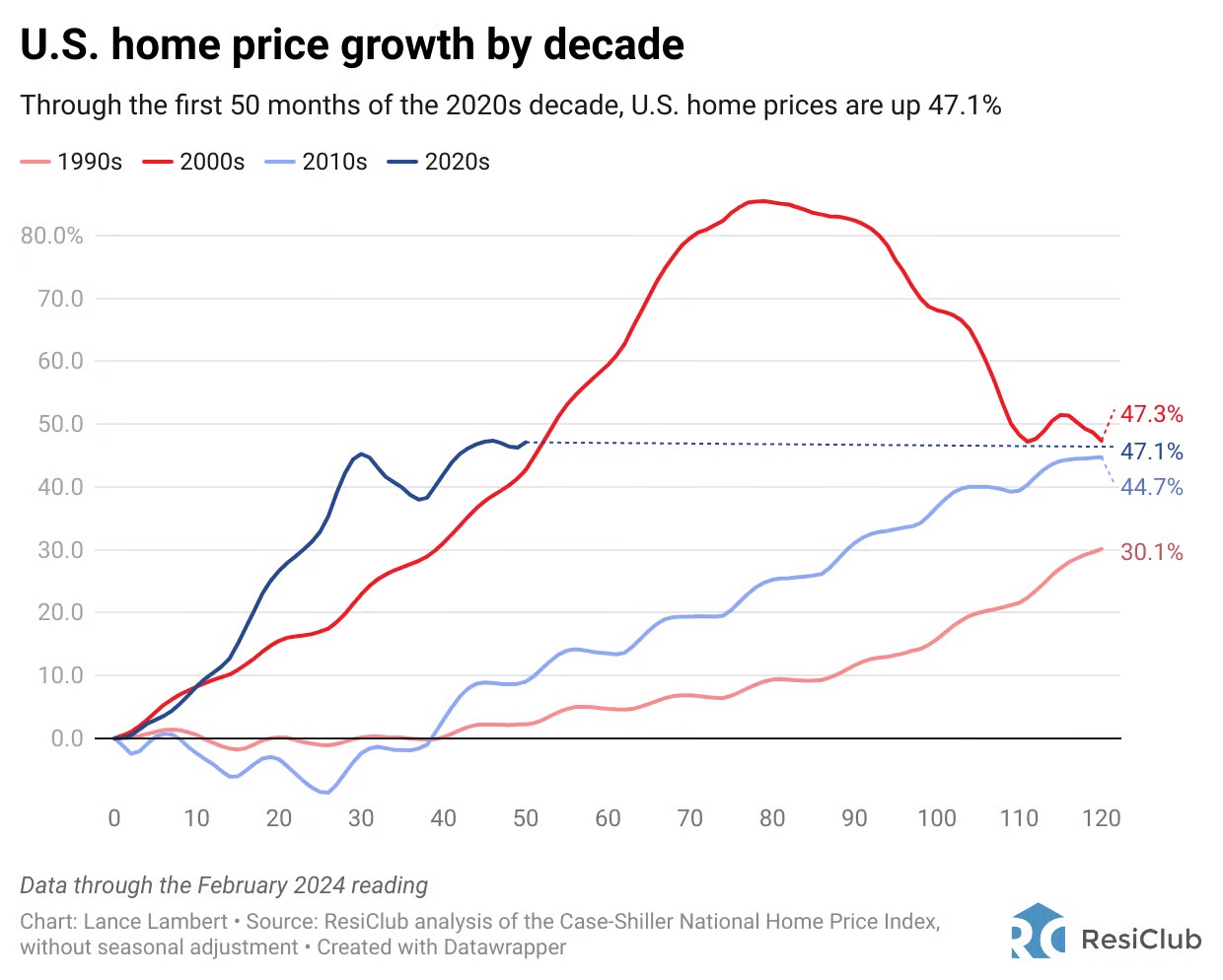
According to ResiClub’s analysis of the Case-Shiller data, U.S. home prices have increased 47.1% through the first 50 months of the 2020s.
Let that sink in. We are not even halfway through the decade, and price appreciation has already matched or exceeded full-decade gains from prior eras.
That pace of home price appreciation has understandably sparked debate. Is this a bubble? Is this normal inflation? Or is this simply the result of historic supply shortages, demographic demand, and low mortgage rates earlier in the decade?
How the 2020s Compare to Past Decades
Here’s how national home price growth stacks up by decade:
- 1990s: +30.1%
- 2000s: +47.3%
- 2010s: +44.7%
- 2020s (first 50 months): +47.1%
Notice something important. The 2000s are often remembered for the housing crash, yet total growth across that entire decade was 47.3%.
The 2010s delivered 44.7% growth across ten years. The 2020s have nearly matched those numbers in less than half the time.
That does not automatically mean prices will continue rising at this pace. But it does show that strong decade-level growth is not unprecedented.
Is the 2020s Market an Outlier?
So far, yes, in terms of speed.
The real estate market experienced an unusual combination of forces early in the decade:
- Historically low mortgage rates
- Pandemic-driven relocation and remote work shifts
- Severe housing supply constraints
- Millennial household formation hitting peak years
When strong demand meets limited inventory, prices rise. That dynamic played out across much of the country, especially in fast-growing Western markets.
However, what history shows us is that while growth rates can slow, long-term home price growth has tended to trend upward over decades, even when corrections occur along the way.
What This Means for Buyers and Sellers
1. Real Estate Remains a Long-Term Investment
Across decades, the data reinforces a core principle: real estate has historically rewarded long-term holders.
Even the 2008 downturn, while severe, was followed by recovery and new highs. That does not eliminate risk, but it does support the case for real estate as a long-term investment rather than a short-term trade.
2. National Trends Do Not Equal Local Reality
The national housing market can mask regional differences. Some cities are cooling. Others remain tight due to limited inventory.
That is why understanding local market data matters far more than reacting to headlines.
3. Strategic Timing Matters More Than Perfect Timing
Waiting for prices to collapse has historically been a difficult strategy. Buying or selling decisions are usually better tied to life changes, financial readiness, and long-term goals rather than trying to outguess the market.
How This Applies to Boise, Meridian, and Nampa
In Idaho, particularly in the Boise metro area, we experienced significant home price appreciation during the early 2020s.
Nampa, Meridian, Boise, and surrounding communities like Kuna, Caldwell, Star, and Eagle all saw elevated demand during peak migration years.
While the pace of growth has moderated compared to the 2021 surge, the long-term trajectory remains supported by:
- Population growth
- Limited new construction relative to demand
- Continued interest in lifestyle markets
If you are buying, this means focusing on value within your budget rather than waiting for a dramatic nationwide reset.
If you are selling, it means understanding how your specific neighborhood compares to broader national numbers.
Garrett Pancheri and the Living in Idaho team work with clients across the Treasure Valley to interpret this data at the local level, not just the national headline level.
Final Thoughts
The 2020s housing market has moved faster than most people expected. But when you zoom out, the pattern of long-term growth in home prices is not new.
Every decade has delivered meaningful appreciation. The difference in the 2020s has been the speed.
The real question is not whether this decade is unique. It is whether your strategy aligns with your timeline and goals.
If you want to explore current pricing trends in Boise, Meridian, Nampa, or anywhere in the Treasure Valley, call or text 208-880-2890 for a data-driven conversation.
Categories
Recent Posts









Leave a Reply